
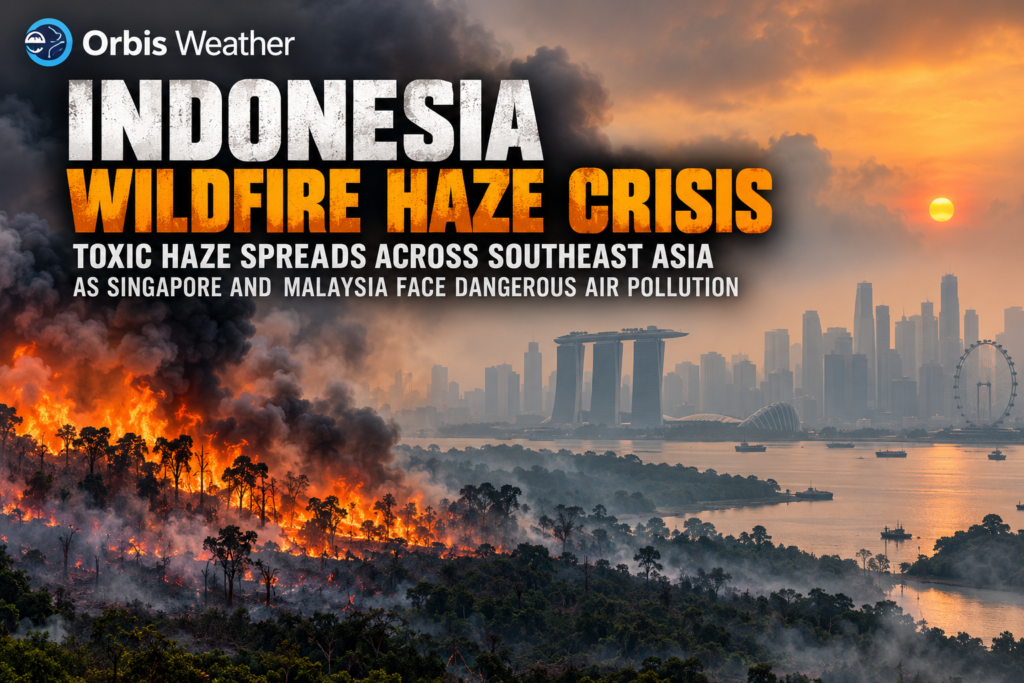

Indonesia Wildfire Crisis: Toxic Haze Spreads Across Southeast Asia as Singapore and Malaysia Face Dangerous Air Pollution
By Paul Harrison | Orbis Weather | Saturday, October 17, 2026
JAKARTA, INDONESIA — Months of devastating forest and peatland fires across Indonesia have triggered one of Southeast Asia’s most serious air pollution emergencies in years, sending thick smoke across international borders, disrupting businesses, closing schools, grounding flights, and exposing millions of people to potentially harmful air.
The wildfire crisis, intensified by unusually dry conditions associated with a strong El Niño, has affected large areas of Indonesia, particularly Sumatra and Kalimantan, while prevailing winds have carried smoke into Singapore, Malaysia, and other parts of Southeast Asia.
As of October 17, Singapore continues to experience unhealthy air quality, with government forecasters warning that pollution could worsen again on Sunday.
Indonesia is also confronting a mounting public health emergency, with more than 283,000 respiratory illness cases reported across seven provinces affected by the fires, according to Reuters.
Singapore Air Quality Remains Unhealthy as Smoke Continues to Drift Across the Region
Singapore’s National Environment Agency (NEA) reported that the country’s 24-hour Pollutant Standards Index (PSI) ranged from 130 to 199 at 7 p.m. local time Saturday, placing air quality firmly within the Unhealthy category.
The agency also reported hourly PM2.5 concentrations between 106 and 198 micrograms per cubic meter, reflecting elevated levels of fine particulate pollution.
For Sunday, October 18, authorities forecast PSI readings between 150 and 220, potentially reaching the Very Unhealthy category.
SINGAPORE AIR QUALITY — OCTOBER 17
Observed 24-hour PSI
130–199
Unhealthy
October 18 forecast
150–220
Unhealthy to Very Unhealthy
Singapore’s Meteorological Service explained that southeasterly winds continued transporting smoke from fires in Kalimantan toward the island nation.
Although showers and changing wind patterns may temporarily reduce pollution, smoke from Sumatra could continue affecting Singapore in the coming days.
The latest conditions have also prompted authorities to recommend limiting outdoor activity, especially for children, older adults, pregnant women, and people with existing heart or respiratory conditions.
Indonesia’s Forest and Peatland Fires Continue Burning
The environmental emergency is centered on Indonesia’s extensive forest and peatland regions, where fires have been burning for months.
Sumatra and Kalimantan are among the hardest-hit areas, with persistent dry weather allowing vegetation and underground peat deposits to ignite and continue smoldering.
Peat fires are especially difficult to extinguish because they can burn beneath the surface, producing smoke long after visible flames have been controlled.
Unlike ordinary surface vegetation fires, burning peat can release large quantities of carbon dioxide and fine particulate pollution.
Indonesia’s firefighting response has involved tens of thousands of personnel, aircraft, and weather-modification operations intended to encourage rainfall.
Reuters reported that more than 60,000 personnel and approximately 50 aircraft had been deployed in the response, although operational figures may change as conditions develop.
The scale of the disaster has also raised concerns about forest management, agricultural land clearing, enforcement of burning restrictions, and the protection of Indonesia’s remaining tropical ecosystems.
Malaysia Faces School Closures, Business Disruptions and Travel Problems
The wildfire haze has created serious challenges for neighboring Malaysia, where deteriorating air quality has forced authorities to restrict outdoor activities and close schools in affected locations.
In parts of the country, the smoke has reduced visibility, creating problems for motorists, airlines, tourism operators, and businesses dependent on outdoor activity.
The aviation industry has experienced particularly noticeable disruptions.
On October 13, Malaysian airline Firefly extended the cancellation of flights between Kuala Lumpur’s Subang Airport and Singapore’s Seletar Airport because of haze and weather conditions.
The economic consequences extend beyond aviation.
Restaurants with outdoor seating, tourism businesses, recreational operators, construction companies, and other industries can face reduced activity when prolonged haze makes outdoor conditions uncomfortable or potentially unsafe.
These disruptions illustrate how a wildfire emergency originating in one country can quickly develop into a wider regional economic problem.
Health Emergency: Why Wildfire Smoke Is Dangerous
One of the most concerning aspects of the Indonesian wildfire crisis is the widespread exposure to PM2.5, microscopic airborne particles measuring 2.5 micrometers or smaller.
These particles can penetrate deep into the lungs and, in some circumstances, enter the bloodstream.
Prolonged or intense exposure can worsen respiratory and cardiovascular conditions, particularly among vulnerable populations.
Common effects of wildfire smoke exposure include:
Irritated eyes, nose, and throat
Persistent coughing and breathing discomfort
Worsening asthma symptoms
Increased respiratory infections and complications
Greater cardiovascular stress among vulnerable individuals
Reduced tolerance for strenuous outdoor exercise
The health burden is already substantial.
Reuters reported more than 283,000 respiratory illness cases across seven Indonesian provinces affected by the fires. However, that figure should not be interpreted as proof that every reported illness was caused exclusively by wildfire smoke.
Singapore has also introduced additional healthcare support for residents affected by haze-related illnesses, including subsidized treatment for eligible patients.
Strong El Niño Conditions Are Making the Crisis Worse
A major factor behind the prolonged wildfire emergency is the development of strong El Niño conditions across the tropical Pacific.
El Niño is a naturally occurring climate pattern involving changes in ocean temperatures and atmospheric circulation.
Across parts of Indonesia and the surrounding Maritime Continent, El Niño can suppress rainfall and increase the likelihood of prolonged dry conditions.
When combined with agricultural burning, dry vegetation, and vulnerable peatlands, these conditions can dramatically increase wildfire risk.
The ASEAN Specialised Meteorological Centre (ASMC) expects below-normal rainfall across much of the southern ASEAN region during the October–December period, accompanied by above-normal temperatures across much of Southeast Asia.
The agency warns that the combination of El Niño and insufficient rainfall could maintain elevated wildfire activity and the risk of smoke crossing international borders.
However, El Niño does not directly ignite wildfires. Human activity, land management, and ignition sources remain critical factors in determining where fires begin.
Southeast Asia’s Haze Crisis Could Continue for Weeks
The World Meteorological Organization has warned that the regional haze emergency could persist for weeks or potentially months unless changing weather patterns bring substantial rainfall.
Ben Churchill, director of the WMO Regional Office for Asia and the Pacific, described the ongoing pollution as one of the region’s most serious transboundary haze episodes.
The prolonged dry season, combined with El Niño conditions, has made firefighting operations particularly challenging.
The WMO has also emphasized the importance of regional cooperation, improved early-warning systems, and stronger wildfire prevention measures.
Rainfall expected during the transition toward the inter-monsoon period could help suppress fires later in October or November.
Nevertheless, isolated showers may provide only temporary relief if underground peat fires continue burning.
Singapore Moves Toward Action Against Companies Linked to Fires
The crisis has renewed scrutiny of companies and landowners potentially connected to fires contributing to the regional haze.
On October 17, Malaysian news agency Bernama reported that Singapore planned to issue preventive-measure notices to seven companies in Indonesia suspected of involvement in fires that contributed to the smoke affecting Singapore.
Under Singapore’s Transboundary Haze Pollution Act, authorities can investigate and pursue action against entities linked to pollution affecting the country.
The proposed notices require measures such as deploying firefighting personnel, stopping burning activities, and developing plans to prevent additional fires.
The companies’ legal responsibility has not been established merely by the issuance of notices, and further investigation is required.
The issue highlights a longstanding challenge for Southeast Asia: preventing fires and managing pollution that does not stop at national borders.
What Happens Next? Southeast Asia Wildfire and Haze Outlook
The immediate outlook remains uncertain, with several weather-related factors likely to determine whether the haze improves or deteriorates.
Rainfall across Indonesia
Widespread, sustained rain would help suppress surface fires and gradually rewet peatlands. Brief showers may not be enough to extinguish deeper fires.
Changing wind direction
Winds shifting away from Singapore and Malaysia could temporarily improve air quality, even if Indonesian fires remain active.
Fire activity in Sumatra and Kalimantan
Continued burning would maintain a major source of smoke and increase the risk of renewed pollution episodes.
El Niño and seasonal rainfall
Persistent dry conditions could delay meaningful recovery, while the eventual arrival of wetter seasonal weather should improve firefighting conditions.
According to Singapore’s October 17 forecast, additional showers and changing winds on Monday and Tuesday could reduce the transport of smoke from Kalimantan. However, haze from Sumatra may still reach Singapore.
How Residents Can Protect Themselves During Hazardous Haze
Health authorities recommend adjusting outdoor activity based on local air quality measurements and individual health risks.
Residents should monitor official air quality information, reduce strenuous outdoor exercise when pollution is elevated, and keep indoor air as clean as practical.
Properly fitted N95 respirators can help reduce exposure to fine particles when outdoor exposure cannot be avoided, although they do not eliminate all risks.
People with asthma, chronic lung disease, heart conditions, or other medical vulnerabilities should follow their healthcare providers’ guidance and seek medical attention if significant symptoms develop.
For Singapore residents, the NEA recommends using the 24-hour PSI forecast when planning activities and the one-hour PM2.5 reading when making immediate decisions about going outdoors.
Orbis Weather Analysis: A Regional Environmental Crisis That Extends Beyond Indonesia
The Indonesian wildfire emergency demonstrates how closely connected Southeast Asia’s weather, ecosystems, economies, and public health systems have become.
What begins as a forest or agricultural fire in one location can become an international air pollution problem when atmospheric conditions carry smoke across borders.
This year’s prolonged dry conditions have made that connection especially visible.
The crisis also reveals the limitations of relying exclusively on emergency firefighting. Prevention, peatland restoration, improved land management, stronger enforcement, and coordinated regional monitoring all play important roles in reducing future haze emergencies.
For Singapore and Malaysia, the immediate priority is protecting public health while waiting for weather conditions to improve.
For Indonesia, the challenge is both immediate and long-term: controlling existing fires while reducing the conditions that allow destructive burning to recur.
The bottom line: Southeast Asia’s wildfire haze emergency is not over. Although changing winds and increased rainfall could provide periods of relief, persistent fires and El Niño-related dryness mean unhealthy air quality may remain a threat through the remainder of October and potentially beyond.
Orbis Weather will continue following regional wildfire developments, air quality conditions, and the changing weather patterns influencing smoke movement across Southeast Asia.